The use of 'censure’
as a political tactic

Despite being targeted by some of my fellow Governing Board members and administrators, my focus has remained on students, student needs, equity and equality for ALL employees on campus, and the future of Southwestern College, including who the next campus president will be.
The hiring of the next SWC campus president is the biggest and most important decision (and process) that will be made at SWC in the coming months.
The creation of the “hiring process,” and not just the actual selection of the campus president, will be politicized by those trying to control who gets to sit on the committee.
This is part of the reason for the power plays that we are currently seeing in the SWC GB races. The GB seats are supposed to be non-partisan; however, there is a definite strategy by powerful factions in the Democratic Party to control and dominate the majority of elected seats in the South Bay.
In my opinion, this includes SWC GB members Galicia-Brown, Segura, and Dumas. The three of them are running their own candidates against SWC GB Trustee Robert Moreno and against me, so that they can control who gets “selected” to become the next SWC campus president.
In my opinion, there are two reasons for this. The first reason has to do with race and ethnicity. Several SWC administrators, campus leaders, and these SWC GB members run SWC based on the ideology of reparations. They don’t care that there are two Chicano/Latino/Indigenous (CLI) students for every one student of any other race/ethnicity. They don’t think that the CLI community in the South Bay deserves to have “representation” at SWC even as one of our Higher Education Centers is located on the border of California and Mexico. There were twelve years of SWC being “led” by three “qualified” white women in a row. Campus employees told past GB members that they didn’t think that “Latinos could do diversity.”
Our current CLI campus president has resigned. I think that these GB members and campus employees have been satisfied with his loyalty to the ideology of reparations. I would like the students at SWC to experience what it would be like if SWC and the South Bay community hired a campus president who supported the “majority’ of the students on campus.
Maybe there would be the twelve PUENTE programs that would bring equity in access to the Learning Communities on campus.
Reason two has to do with money and who is in charge of it. Dumas and his “group of Dems” want to control who decides how the bond committees at Chula Vista Elementary, Sweetwater High School, and the SWC District spend the 300 million, the 600 million, and the 800 million in bond money.
How will that 1.7 billion dollars in bond money get spent? I know that the building unions are very interested in the answers to that question.
I have been pro-union all my life. However, witnessing “a union” trying to buy the Chula Vista City Council was outrageous. Thank God that people in Chula Vista called out the “59 percent raises” that the City Council tried to give themselves, and then they called out the even more outrageous “raises” that the members of the Chula Vista Elementary School District “voted” to give themselves.
I was mad when the President’s Office at SWC arranged for Don Dumas and his girlfriend to travel along with a group of administrators and students to the country of Ghana. (I believe that the girlfriend’s travel was paid for privately.)
No one from the SWC President’s Office asked SWC GB Trustee Robert Moreno or me if we wanted to travel to Mexico, with our significant others in tow. Why not?
Elected service should not be about power-grabbing or empire-building or traveling at taxpayer expense. It is about being a steward of important community resources. It is highly evident that not all Democrats believe that.
Apparently, some run for office for the purposes of monetary self-enrichment, travel, and seeking titles, status, and prestige.
Equal Opportunity, Transparency, and Accountability at Southwestern College
I want the South Bay community to understand why I have continued to speak out during the past four years and why I remain committed to serving on the Southwestern College Governing Board.
I have experienced a sustained effort to “erode” my voice, “isolate” me from my colleagues, and discourage me from asking difficult questions about transparency, accountability, and equity at Southwestern College during the four years (inclusive) that I have been on the board.
At present, former SWC GB president Don Dumas is trying to “separate” me from my work at the college by running a candidate against me. The terms “erode, isolate, and separate” come from the dissertation of former campus president Melinda Nish. Her dissertation includes a step-by-step process for removing anyone who disagrees with the administration or with their fellow GB members.
A Trustee Should Be Able to Speak Independently
I ran for the Governing Board in the fall semester of 2022, upon the advice of my attorney. My faculty union leaders at that time refused to represent me. They allowed campus president Sanchez to violate eight sections of the faculty contract to keep me from returning to campus in my role as a tenured faculty member.
At the time, I had already spent more than 30 years serving Southwestern College as a tenured Counselor and Professor. During that time, I had also served my colleagues through the Southwestern Community College District faculty union, SCEA, including as Faculty Union President, Lead Negotiator, and Grievance Chair.
I worked my way through virtually every level of union leadership, serving as Secretary, Treasurer, and Vice President before being elected President.
I had spent decades learning how Southwestern College worked, advocating for employees and students, and building relationships throughout the institution.
My decision to run for the Governing Board was because of the lack of due process rights that the campus president and the then leaders of the faculty union had colluded to deny me. I had spent $55,000 out of pocket to pay a private attorney for representation that paying 30 years of union dues should have guaranteed me by the fall of 2022.
I needed to bring my experience as an advocate, my institutional knowledge of the college, and my perspective as a longtime employee and community member to the Board. If the president of the college and the then faculty union leaders could violate the faculty contract, treating me, an honest, open, transparent, dues-paying campus gadfly, in such a disparaging, racist, and sexist manner, what would they do to other non-experienced, non-extraverted campus employees?
What Happened Before I Ran
Before I ran for the Governing Board, the former campus president, Kindred Murillo, had placed me on “involuntary paid administrative leave” twice.
The first time was because I had lobbied to have a fellow counselor removed from the hiring Committee for the position of Dean of Counseling. This campus employee had publicly stated that she was on that hiring committee and that she felt the Filipino Department Chair of Counseling was not qualified for promotion to Dean of Counseling. She made this biased statement in a Counseling meeting before the hiring committee had even met.
Murillo placed me on “involuntary paid administrative leave” in 2018 so that she could dictate the outcome of the hiring process for the Dean of Counseling position. She insisted on doing so without any semblance of fairness, equity, equality, or justice. This was the same year that she “canceled” the outcome of the student ASO elections because members of the Black and White campus communities were unhappy that a multicultural slate of student candidates had won the elections, as it turned out, quite fairly and squarely. (SWC paid over $200,000 on the investigation)
The second time I was placed on “involuntary paid administrative leave” was because I had advocated in writing for the Governing Board to consider hiring a qualified Chicano, Latino, or Indigenous leader to succeed President Murillo after she announced her departure in 2020.
SWC had hired three qualified White women presidents in a row. These hirings covered a period of twelve years. There was, of course, a scandal in the hiring process for Murillo, the third person in that series of hirings. The Black and White employee coalition on campus refused to promote the most qualified candidate in the hiring pool. This woman was a long-term campus employee who was deemed unqualified by members of that group because they felt that “Latinas/os can’t do diversity.”
For me, there was a larger issue to consider. Between 2016 and 2020, the percentage of Chicano, Latino, and Indigenous students at Southwestern College grew from 48 percent to 70 percent.
I believed — and still believe — that leadership should reflect and understand the communities we serve.
My advocacy was not based simply on my own ethnicity or surname. I was looking at the changing demographics of Southwestern College and at how a “new” majority of students should be served, if only because their family members were contributing significantly to the local taxpayer dollars that were and are coming from our local South Bay communities.
From a business, marketing, and institutional perspective, I believed that hiring and promoting highly qualified leaders from those communities would send an important message:
Southwestern College should practice what it teaches — that education, opportunity, hard work, and professional development should open doors.
Kindred Murillo spent the four years of her presidency pursuing a reparations policy for members of the Black community. She created a “policy of hiring and promoting from within” that benefited both Black and White campus employees.
Beyond that, she chose to simply “appoint” people to positions on campus. She did away with establishing hiring committees. The goal of hiring and promoting based on “merit and qualifications” went right out the window. She simply appointed employees to positions she felt they should have because she “liked” them.
This included the Vice-President for Student Services position. This Vice-Presidential position paid close to 200,000 dollars a year. Even though there were several Counselors with doctorates and lengthy resumes at SWC, Murillo jumped right over them, ignoring their loyalty and professionalism at SWC. The person she appointed later became president of one of San Diego City College’s programs.
Murillo had no investment or care for her own employees at SWC. She didn’t care about their career goals or the importance of their career pathways. She didn’t care if they wanted to become campus presidents someday. She coldly, callously, and deliberately bypassed them. Many White employees of the campus supported her in these actions.
She engaged in favoritism and patronage to the extent that she even CANCELLED the outcome of the ASO student elections in 2018 because a multicultural slate of student candidates defeated a slate of Black student candidates.
The investigator of that trauma charged at least $200,000, finding that the multicultural slate had indeed won the elections fairly and squarely. Two Black employees who worked in Student Activities were found to have aided the Black slate of student candidates unfairly. Murillo gave those two employees “verbal reprimands” while she fired the white Director of Student Activities and the white Dean of Student Services. Her “decisions” resulted in lawsuit/s against the District.
Why did my faculty union allow Murillo to retaliate against me when I was just asking for representation for the brown communities on campus? The newer white male faculty union president and the white male grievance chair colluded with Murillo to the extent that the grievance chair was appointed by Murillo to the position of “Interim Vice-President of Human Resources” from one day to the next. The grievance chair, who was supposed to defend and advocate for me and for honoring our faculty union contract, “represented” himself instead, right into a big raise, a title, power, and status.
At the end of Fall 2020, two very important SWC GB members stepped down from the GB. Nora Vargas was elected to the San Diego County Board of Supervisors, and Tim Nader was elected to the position of Judge. Right before they left, the two of them voted to hire a qualified Chicano/lLatino/Indigenous campus president. (Sanchez). They didn’t have to worry about how being labeled “anti-Black” could impact their election campaigns anymore.

My Concern Has Always Been Representation and Opportunity
My concern has never been about excluding anyone because of race or background.
It has been about making sure that qualified people from every community have a fair opportunity to advance.
Southwestern College serves a student population that is overwhelmingly diverse. As of 2025-2026, the demographics are as follows:
Hispanic: 19,014 White: 2823
Filipino: 2029 Af Am: 1266
Unknown: 1058 Multi-eth.: 954
Asian: 689 Pac Is: 86
Nat Am: 38
Total: 29292
I believe those students deserve to see themselves reflected throughout the institution — including in leadership.
At the same time, I believe every employee, regardless of race, ethnicity, gender, or background, deserves a fair opportunity to advance based on their qualifications, experience, and commitment.
That principle is especially important to me because I saw longtime Southwestern College employees — many of whom had spent 15, 20, or 30 years serving the institution — watching opportunities pass them by.
Many had earned advanced degrees, developed deep institutional knowledge, and devoted their professional lives to our students.
I believe those employees deserve to be considered seriously when leadership opportunities become available.
That is why I voted against hiring the candidates whose names were forwarded for three Dean positions at SWC that had finally opened after years and years. President Sanchez filled ALL three positions, with two candidates being from outside of San Diego County and one candidate being from out of state.
The position of Dean of the Higher Education Center in National City was filled by a candidate who came from Shasta County. Shasta County is on the very opposite side of California from Chula Vista, California. Shasta College has a rural location with predominantly white students.
The National City Higher Education Center is urban with a very diverse population. Mexicano, Pilipino, and Whites dominate the demographics there. As a career, academic, and personal Counselor, I don’t see immediately transferable skills here.SWC will have to pay at least two years of “learning curve’ salaries before this person can become the leader that National City deserves.
The position of Dean of both the Higher Education Center in Otay Mesa and the position of Dean at the San Ysidro Higher Education Center was filled by someone from Ventura County. The demographics, again, are different, and the skills and experiences that this candidate brings would be excellent for someone working in Outreach and the Mid College Program but not necessarily for the San Ysidro Center.
The original job description for overseeing the San Ysidro Center stated that the person who was to be the lead there should be at the very least bilingual in Spanish and English, because that center is located on the border of California and Mexico. The person who was hired as the lead there should also have knowledge and experience of working with fronteriza populations.
That job description was changed because members of the Black community at the college felt that these requirements were discriminatory against them. The fact that deleting these requirements, when they had specifically been included in the job description because of the way that the college got the land that the San Ysidro Center is located on, was cruelly dismissed due to what I consider to be “selective wokeness.” (In that, SWC is “woke” for some communities and then ignores the needs of the “new” majority of students.)
SWC got the land where the San Ysidro Center is located due to Chicano/Latino/Indigenous people being deliberately hunted down and murdered BECAUSE of the color of their skin. Such a job description should have included, at the very minimum, a requirement of “cultural competency.”
This would be the least that leaders of SWC could offer in terms of honoring the lives that were lost and the blood that was shed there.
As usual, however, brown people at SWC requesting representation, specifically at the San Ysidro campus, were met with denial from leaders at SWC, including GB members Segura, Galicia-Brown, and Don Dumas.
The Disconnect Between What We Teach and What We Practice
These issues matter so much to me because Southwestern College tells students that education and hard work can change their lives.
I have dedicated much of my career to that message. But I also believe we need to practice what we teach.
When a longtime employee earns an advanced degree, develops expertise, serves students for decades, and contributes to the college, that employee should be able to see a pathway toward professional advancement.
Our employees should not have to watch opportunities repeatedly go to candidates from outside the region without understanding how those decisions were made or whether internal candidates received a meaningful opportunity to compete.
If we tell our students that education creates opportunity, our own institution should demonstrate that principle.
That is the standard I want for Southwestern College.
My Experience Under New Leadership
When Dr. Mark Sanchez became Superintendent/President in 2021, I returned to campus following another period of involuntary paid administrative leave. I expected to return to the tenured Counselor/Professor position I had held for more than three decades without a student complaint.
Instead, my return to my previous responsibilities was different from what I expected.
I was assigned to teach Personal Development classes that at times had extremely low enrollment, including one with only one student.
I was also appointed to a project but was not effectively integrated into the project team. Other members were apparently unaware that I had been assigned to the project, and as a result, I was not included in meetings.
From my perspective, these experiences contributed to a pattern of feeling increasingly isolated from the institution I had served for decades.
It was difficult, but it also reinforced my belief that I needed to continue speaking up. Persistence is one of the things we teach our students. We teach them to “never tell themselves no” and to “never give up, no matter what.”
Why I Ran for the Governing Board
My decision to run for the Governing Board was not about obtaining a title.
It was about having a seat at the table.
I believed that my experience as a counselor, professor, union leader, longtime employee, and member of the South Bay community gave me a perspective that could benefit the college.
I wanted to advocate for students. I wanted to advocate for longtime employees. I wanted to ask questions about how decisions were being made.
And I wanted to make sure that Southwestern College remained accountable to the community it serves.
That remains my motivation today.
The Importance of Representation
CLI and Pilipino students make up the majority of students on the campus; however, White and Black faculty make up the majority of the Academic Senate and faculty union representatives. The Academic Senate and the faculty union “appoint” the members of the “hiring” committees on campus.
At this time, the “demographics” on campus in terms of employee make-up do not allow for “brown power” on campus.
Long-term campus employees, people who are amongst the “first in their family” to go to college, must sit by and watch while Sanchez hires people from outside San Diego County and outside California over them.
Long-term SWC employees who have waited decades for positions to open so they could be promoted after 15, 20, or 30 years of service must sit by and watch as Sanchez and his “stacked” hiring committees decimate the hopes and dreams of our long-term SWC campus employees.
I believe these issues regarding how SWC administrators have been inequitable in how they “hire, promote, and discipline” campus employees are worth discussing openly.
Representation means making sure that every qualified voice has an opportunity to be heard.
When students walk onto a college campus, they should be able to see people who understand their communities, families, experiences, and aspirations. And when employees dedicate decades of their lives to Southwestern College, they should believe that their service, education, and professional accomplishments can lead to meaningful opportunities.
Censure and Board Leadership
I have been “censured” twice by my fellow SWC GB members. The first censure was initiated by former GB president Roberto Alcantar. The second censure was merely a continuation of the first censure. The second censure was initiated by Don Dumas when he became GB president in 2024. The most interesting aspect of the second censure is that it has no ending date.
The censure votes were instituted quite simply to prevent me from participating equally in Board leadership, including the opportunity to seek the positions of Vice President and President.
Keeping brown people at SWC from having any power, from having equal input into how decisions, policies, and procedures are made and created, has been ongoing at SWC since at least 2016.
My fellow SWC GB want to keep the status quo. They are not invested in equity, equality, or fair representation for the majority of students on campus.
In my opinion, and based on my lived experience, their goals are to control the college by controlling the selection process for the new campus president.
They want to continue to work in collusion with those on campus who “appoint” people to the hiring committees so that they can “stack” the hiring committee for the campus president, thereby “controlling” the college for years to come.
I believe every trustee elected by the community should care about the long-term interests of our students, whomever they may be.
Service on the SWC GB is supposed to be non-partisan.
Sadly, SWC GB president Kris Galicia-Brown, Vice-President Nick Segura, and Don Dumas have turned the 2026 SWC GB elections into a battle with Democrats attacking and slandering other Democrats out in the larger South Bay community. It’s embarrassing.
Cease and Desist
I have alluded to the significant disagreements fellow Governing Board member Don Dumas has had with me to the extent that I recently served him with two cease-and-desist requests.
I believed certain verbal attacks directed toward me have crossed the line from political disagreement into slander.
I strongly believe in the right to disagree while also maintaining that elected officials have a responsibility to foster respectful public dialogue.
We can disagree without diminishing one another.
I asked the three GB members at the August 2026 GB meeting to bring in an outside conflict resolution mediator to work with us in establishing standards to ensure that minimal reputational damage will happen to the college and to us, but as usual they ignored my very professional request.
Transparency and Accountability
One of my greatest concerns is how Dumas, Segura, and Galicia-Brown have chosen to protect the current administration from greater scrutiny.
Their political relationships make it more difficult for the Board to independently evaluate the administration and demand the transparency and accountability that taxpayers, students, employees, and the community deserve.
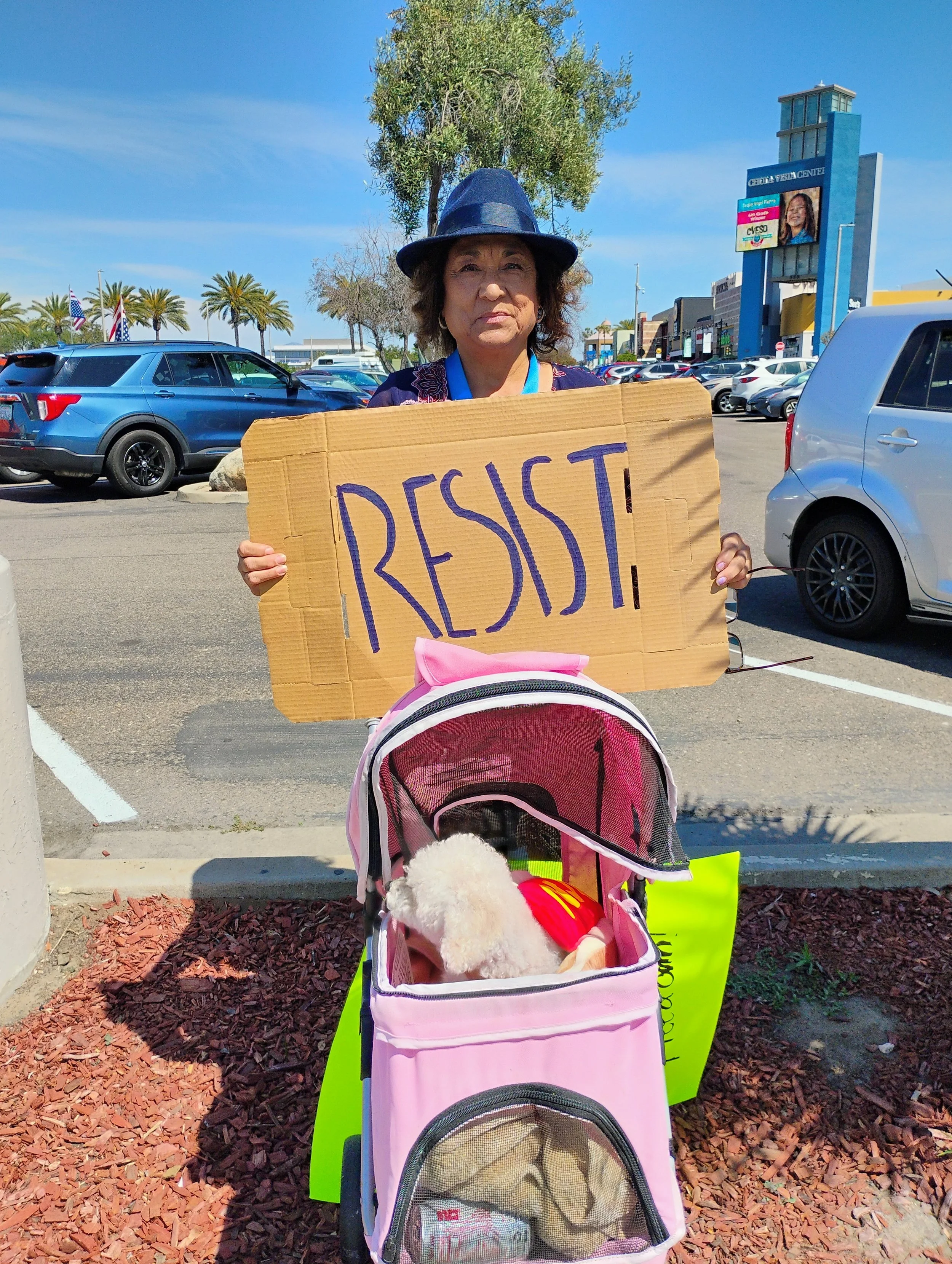
That is why I continue to believe in a “No Kings” philosophy — not just in our country, but at Southwestern College.
No individual should be above accountability:
Not a trustee. Not a Board officer. And not the college president.
The College President Should Be Accountable, Too
I believe the Superintendent/President deserves the opportunity to lead and deserves the support necessary to do the job well.
But support and accountability are not opposites.
The college president should be evaluated through a fair, thorough, transparent, and meaningful process consistent with the responsibilities of the position.
Faculty members, classified employees, and administrators must all undergo evaluation. I believe that the Superintendent/President should also be held to appropriate standards of performance and accountability.
Asking for that accountability does not mean that I oppose the president. Rather, it means I believe in responsible governance.
A strong governing board should be able to support its president while still asking difficult questions.
Why I Continue to Speak Up
I know that my willingness to challenge the status quo has made me unpopular with some people. I understand that, and that is ok.
I would rather be an independent voice than remain silent when I believe something deserves greater examination. I ran for the Governing Board because I believed students deserved a trustee who would listen to them. I believed employees deserved a trustee who understood their concerns. And I believed the South Bay community deserved a trustee willing to ask questions on its behalf.
That is still who I am.
Looking Forward
Southwestern College needs to become a stronger, more transparent, more equitable, and more student-centered institution.
I want a Governing Board where trustees can disagree without becoming enemies. I want employees to believe that their dedication and education can lead to opportunity. I want students to know that their concerns are heard. I want the college to be accountable to the community that supports it. And I want every elected trustee to have an equal opportunity to contribute and lead.
My message to the South Bay community is simple:
I am not running to tear down Southwestern College. I am running because I believe in what Southwestern College can become.
I believe in our community. And I believe that transparency, accountability, representation, and opportunity make our institution stronger — not weaker.
I will continue to ask difficult questions and advocate for students. And I will continue to believe that no matter who you are, where you come from, or what your position is, everyone deserves a fair opportunity to be heard, to participate, and to succeed.
That is the Southwestern College I believe in. And that is the Southwestern College I will continue working toward.